Nature | Hu Zheng, He Xionglei and He Zhen labs reveal a new evolutionary model of early tumour transition from polyclonal to monoclonalNature | 胡政/贺雄雷/何真团队揭示早期肿瘤从多克隆至单克隆转变的演化新模式
2024-10-31
Understanding the early mechanisms of tumour development is crucial for early prevention and treatment. The traditional Nowell clonal evolution theory holds that a tumour arises from a single cell with an oncogenic mutation, which after continuous expansion and selection eventually forms a malignant tumour. This theory emphasises that tumours have a "monoclonal origin", i.e., a tumour originates from and expands from one cell.
However, our understanding of the precancerous process at even earlier stages is still very limited. For example, in precancerous lesions, do multiple independently mutated cell populations jointly drive tumour development (i.e., a "polyclonal origin")? There is no clear answer yet. Overall, the insufficient understanding of the origin and early mechanisms of tumours greatly limits breakthroughs in precise tumour screening and early intervention.
On 30 October 2024, the team of Hu Zheng at the Shenzhen Institute of Advanced Technology, Chinese Academy of Sciences, together with He Xionglei and He Zhen of Sun Yat-sen University, published a research paper in Nature entitled "Polyclonal-to-monoclonal transition in colorectal precancerous evolution".
The study reveals for the first time a new early evolutionary model of transition from polyclonal to monoclonal tumours, and dissects the cell-cell communication and interaction mechanisms of polyclonal tumour origins. This finding not only provides a new scientific perspective on the early mechanisms of tumour development, but also proposes new ideas for precise early screening and intervention of cancer.
The team established for the first time in mammals a base-editor-based cell lineage tracing technology (SMALT), achieving high-precision lineage tracing at single-cell resolution in mice. SMALT combines a cytidine deaminase (AID), an artificial DNA barcode sequence and a Tet-On inducible expression system; through AID-mediated targeted mutation and subsequent DNA sequencing, it can reconstruct single-cell lineage trees at large scale and high accuracy (Fig. a below).
Using transgenic mice carrying the SMALT system, the team built two classic mouse intestinal cancer models: an inflammation-induced colorectal cancer model (AOM/DSS) and a multiple intestinal neoplasia model (ApcMin/+). In the lineage-tree analysis, the team found that most (66.7%) inflammation-induced intestinal cancers and all Apc intestinal polyps showed a polyclonal origin (Fig. b). By integrating DNA barcode mutations, whole-genome sequencing and single-cell transcriptome data, the team further found that monoclonal tumours (Fig. c) are more malignant than polyclonal tumours, suggesting that monoclonal tumours may represent a later stage of tumour progression. Based on these findings, the team proposed a new "polyclonal-to-monoclonal transition" model of tumorigenesis (Fig. d), providing a new theoretical framework for early tumour evolution.
The team also collected a cohort of 107 patients with sporadic intestinal polyps and concomitant colorectal cancer. Genomic sequencing showed that about 30% of human intestinal polyps are polyclonal in origin, with a lower mutation burden and copy-number variation. Pathological features also showed that, compared with monoclonal polyps, polyclonal polyps are smaller and less malignant; conversely, monoclonal polyps show more genomic variation, larger size and higher malignancy. These findings validate the mouse lineage-tracing results in humans and jointly support the early tumour evolution model of polyclonal-to-monoclonal transition.
Based on the above results, the team proposed a new model of polyclonal-to-monoclonal transition during early tumorigenesis (Fig. d), emphasising the importance of specific genomic and microenvironmental changes and cell-cell interactions. These findings provide a new conceptual framework for understanding tumour origin and propose a new cancer-prevention strategy of targeting cell-cell communication for early intervention. Thus, the study opens a new research field, namely exploring the polyclonal formation mechanisms and cell-cell interactions in early tumorigenesis, providing new ideas for early cancer screening, risk prediction and early targeted intervention.
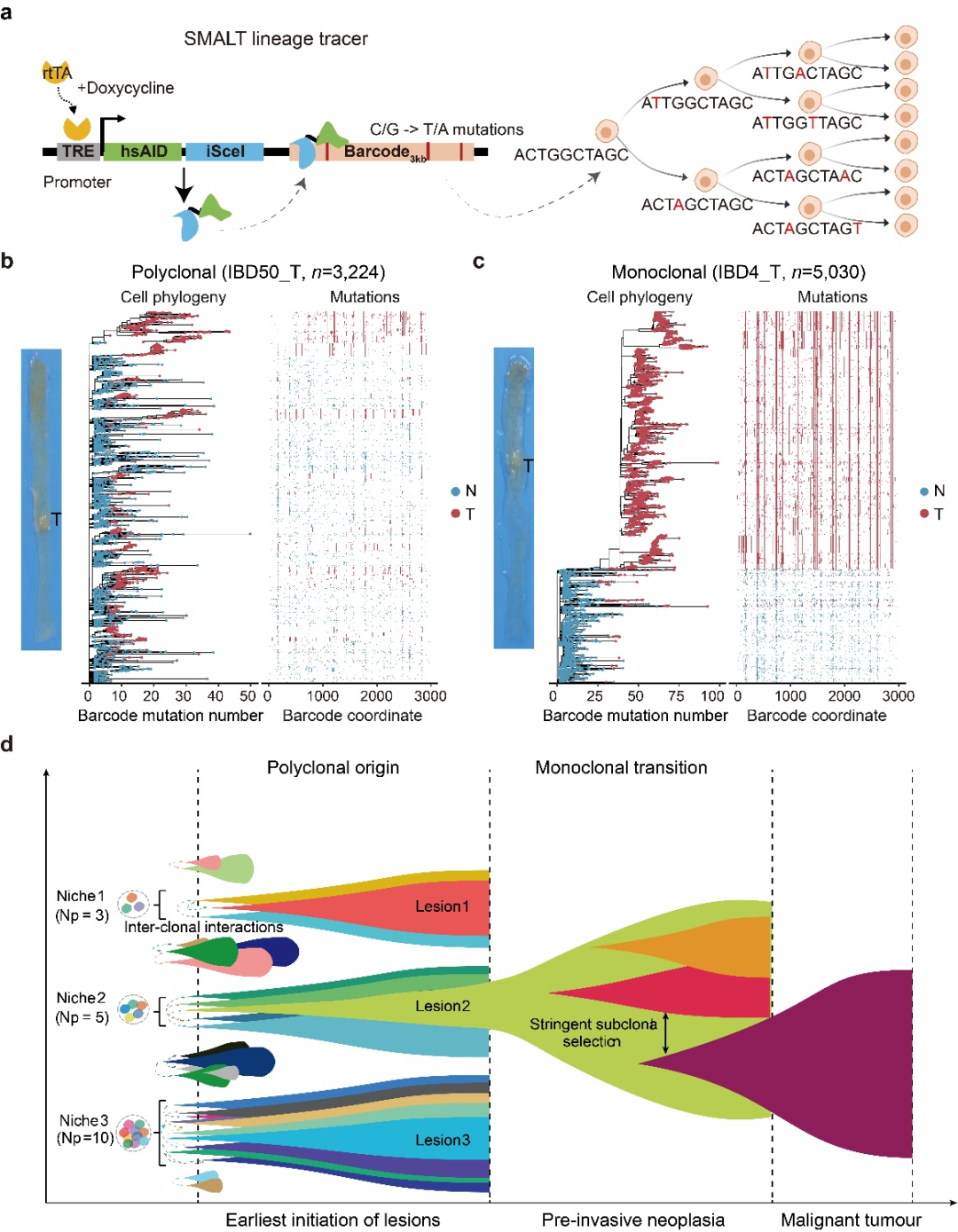
Single-cell lineage tracing of the evolutionary model of early tumour transition from polyclonal to monoclonal
Researcher Hu Zheng of the Shenzhen Institute of Advanced Technology, Chinese Academy of Sciences; Prof. Xionglei He of Sun Yat-sen University; and Prof. He Zhen of the Sixth Affiliated Hospital of Sun Yat-sen University are the co-corresponding authors. Assistant researcher Dr. Lu Zhaolian and Dr. Mo Shanlan of the Shenzhen Institute of Advanced Technology; joint PhD student Xie Duo (SIAT-University of Macau); and PhD student Zhai Xiangwei and postdoc Dr. Shanjun Deng of Sun Yat-sen University are the co-first authors.
理解肿瘤的早期发生机制,对实现肿瘤的早期预防和治疗至关重要。传统的 Nowell 克隆演化理论认为,肿瘤是由一个发生致癌突变的单一细胞引起,经过不断的细胞扩增和筛选,最终形成恶性肿瘤。这一理论强调肿瘤具有“单克隆起源”,即肿瘤由一个细胞起源并扩增而来。
然而,对于肿瘤在更早期阶段的癌前病变过程,我们的了解还非常有限。例如,在癌前病变中,是否存在多个独立突变的细胞群体共同推动肿瘤发展(即“多克隆起源”)?目前这个问题还没有明确答案。总体来说,对早期肿瘤起源和发生机制的认识不足,极大地限制了我们在肿瘤精准筛查和早期干预上的突破。
2024 年 10 月 30 日,中国科学院深圳先进技术研究院合成生物学研究所胡政、中山大学贺雄雷和何真团队合作,在 Nature 期刊发表了题为“Polyclonal-to-monoclonal transition in colorectal precancerous evolution”的研究论文。
该研究首次揭示了肿瘤从多克隆向单克隆转变的早期演化新模式,并解析了肿瘤多克隆起源的细胞间通讯与互作机制。这一发现不仅为肿瘤的早期发生机制提供了新的科学视角,同时也为癌症的精准早期筛查和干预提出了新的思路。
研究团队首次在哺乳动物中建立了基于碱基编辑器的细胞谱系示踪技术(称为 SMALT),实现了小鼠体内单细胞分辨率的高精度谱系追踪。SMALT 技术结合了胞苷脱氨酶(AID)、人工 DNA 条形码序列和 Tet-On 可诱导表达系统,通过 AID 介导的靶向突变和后续 DNA 测序,能够大规模、高精确地重建单细胞谱系树(下图 a)。
研究团队利用携带 SMALT 系统的转基因小鼠,构建了两种经典的小鼠肠癌模型:炎症诱导肠癌模型(AOM/DSS 模型)和多发性息肉模型(ApcMin/+ 模型)。在谱系树分析中,团队发现大多数(66.7%)炎症诱导的肠癌和所有 Apc 肠息肉均表现出多克隆起源(下图 b)。通过整合 DNA 条形码突变、全基因组测序和单细胞转录组数据,研究团队进一步发现单克隆肿瘤(下图 c)比多克隆肿瘤具有更高的恶性程度,这表明单克隆肿瘤可能代表肿瘤进展的更“晚期”阶段。基于这些发现,团队提出了肿瘤发生的“多克隆向单克隆转变”新模型(下图 d),为早期肿瘤演化提供了新的理论框架。
研究团队同时收集了 107 例人类散发性肠息肉及伴发结直肠癌的患者队列。基因组测序数据显示,大约 30% 的人类肠息肉是多克隆起源,且具有较低的突变负荷和拷贝数变异。病理特征也表明,相比单克隆息肉,多克隆息肉尺寸更小、恶性程度更低;相反,单克隆息肉表现出更多的基因组变异、较大尺寸和更高的恶性程度。这些发现在人体中验证了小鼠的谱系示踪结果,共同支持了多克隆向单克隆转变的早期肿瘤演化模式。
基于上述结果,研究团队提出了早期肿瘤发生过程中多克隆-单克隆转换的新模式(下图 d),强调了这一过程中特定基因组和微环境变化以及细胞间相互作用的重要性。这些发现为理解肿瘤起源提供了全新的概念框架,并提出通过靶向细胞间通讯来实现早期干预的肿瘤预防新策略。因此,该研究开辟了一个新的研究领域,即探索早期肿瘤发生中的多克隆形成机制和细胞间相互作用,为肿瘤早筛、风险预测和早期靶向干预提供了全新的思路。
单细胞谱系示踪早期肿瘤从多克隆至单克隆转变的演化新模式
中国科学院深圳先进技术研究院合成生物学研究所胡政研究员、中山大学贺雄雷教授和中山大学第六附属医院何真教授为论文共同通讯作者。中国科学院深圳先进技术研究院助理研究员逯召莲博士、莫珊兰博士;中国科学院深圳先进技术研究院-澳门大学联合培养博士研究生解铎;中山大学博士研究生翟相威、博士后邓善俊博士为论文共同第一作者。