

Advanced Biotechnology | He lab at Sun Yat-sen University uses a new quantitative method to explore the link between somatic clonal expansion and cancer riskAdvanced Biotechnology | 中山大学贺雄雷教授团队采用定量评估新方法探究体细胞克隆扩增与癌症风险的相关性
2024-05-24
Somatic clonal expansion is an important form of cell proliferation in multicellular organisms and has long been considered closely related to the development and progression of cancer. Especially in the blood system, clonal expansion driven by driver mutations is regarded as an important hallmark of haematological malignancies such as leukaemia. Cancer is essentially uncontrolled cell proliferation, and somatic clonal expansion also shows proliferative features; moreover, the driver mutations of the two overlap to some extent. Therefore, the traditional view holds that somatic clonal expansion is a precancerous state of cancer.
Recently, Prof. Xionglei He's group at the School of Life Sciences, Sun Yat-sen University, used a simple quantitative method to mine public data, quantitatively assess the degree of somatic clonal expansion in nine different organs of five human individuals, and compare it in detail with cancer risk data; the study found some results that overturn conventional understanding:
First, the degree of somatic clonal expansion differs markedly among organs. This shows that each organ has its own characteristics and potential for clonal expansion, which may be related to biological features, cell turnover rate, response to damage and environmental factors. For example, organs of the digestive system, frequently exposed to external substances, may need a higher cell turnover rate and thus show different clonal expansion patterns (Fig. 1a).
Second, the degree of clonal expansion of the same organ is basically consistent among individuals of similar age; for a single organ, the level of clonal expansion is similar in the elderly. Further analysis showed that most of the variance in expansion level is contributed by the organ's own characteristics (Fig. 1b-d). This means the intrinsic properties of an organ play a key role in determining its clonal expansion potential. However, owing to the limited sample size, subtle differences among individuals cannot be further resolved, indicating that larger datasets are needed to verify these findings.
Most importantly, the study shows no significant correlation between cancer risk and the degree of somatic clonal expansion in solid tissues (Fig. 1e-f). This challenges the traditional view and reveals a possible independent mechanism between somatic clonal expansion and cancer. Specifically, although somatic clonal expansion is often regarded as a precursor of cancer, in solid tissues such expansion does not seem to translate directly into cancer risk. This suggests a more complex relationship than simple causation.
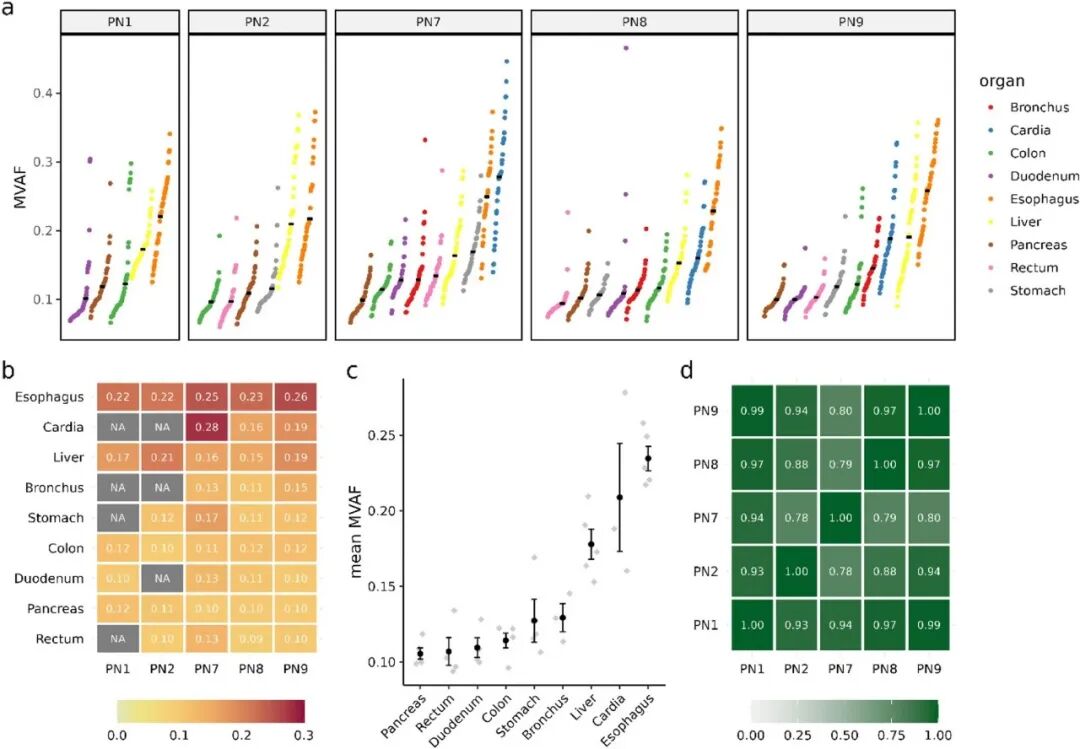
Fig. 1 No significant correlation between multi-organ clonal expansion and cancer risk in human samples
This result suggests that somatic clonal expansion and cancer formation may be two similar but independent somatic evolutionary processes. Studying the rules of somatic clonal expansion will help understand the difference between the benign maintenance of normal tissues and the malignant expansion of cancer. Also, this information is important for studying ageing, since clonal expansion is more pronounced in the elderly. In addition, some diseases (such as Crohn's disease and idiopathic pulmonary fibrosis) may be related to abnormal somatic clonal expansion, so studying it deeply will help reveal the underlying pathological mechanisms and develop corresponding treatments. In cancer prevention and treatment, although there is no evidence that directly targeting clonal expansion can reduce cancer risk, these results provide clues for new strategies. For example, if benign, harmless clonal expansions can be identified, scientists could more precisely screen and monitor clones with potentially malignant transformation risk.
The study, entitled "Variation in cancer risk between organs can not be explained by the degree of somatic clonal expansion", was published in Advanced Biotechnology. Prof. Xionglei He and postdoc Shanjun Deng of the School of Life Sciences, Sun Yat-sen University, are the co-corresponding authors, and Dr. Di Zhang and MSc Ao Zhang are the co-first authors. The study was supported by the National Key R&D Program and the National Natural Science Foundation of China.
体细胞克隆扩增是多细胞生物体内细胞增殖的一种重要形式,长期以来被认为与癌症的发生和发展密切相关。尤其是在血液系统中,驱动突变导致的克隆扩增被视为白血病等血液系统肿瘤发生的重要标志。癌症的本质是细胞的失控增殖,而体细胞克隆扩增也具备增殖的表现和特征。此外,两者的驱动突变存在一定的重合性。因此,传统观点认为,体细胞克隆扩增是癌症发生的前体状态。
近日,中山大学生命科学学院贺雄雷教授团队采用了一种简便的定量评估方法,深入挖掘公共数据,对五个人类个体的九个不同器官的体细胞克隆扩增程度进行了定量评估,并与癌症风险数据进行了详尽的比较分析,该项研究发现了一些颠覆传统认知的结果:
首先,研究发现不同器官的体细胞克隆扩增程度存在明显差异。这一结果表明,各器官在克隆扩增方面有着各自的特性和潜力。这种差异可能与器官的生物学特性、细胞更新速率、对损伤的反应以及环境因素等多种因素有关。例如,消化系统的器官由于频繁接触外界物质,可能需要更高的细胞更新速率,从而表现出不同的克隆扩增模式(图 1a)。
其次,同一器官的克隆扩增程度在年龄相近的个体间基本一致。对单个器官而言,其克隆扩增水平在老年群体中展现出相似的扩增水平。进一步分析表明,器官的扩增水平差异大部分由器官本身特性所贡献(图 1b-d)。这意味着器官的固有特性在决定其克隆扩增潜力方面起着关键作用。然而,由于样本数目的局限性,个体间的细微差异尚无法进行更为详细的拆分,这也提示未来研究需要更大规模的数据集来验证这些发现。
最重要的是,研究显示癌症发生风险与体细胞克隆扩增程度在固体组织中不存在显著相关性(图 1e-f)。这一发现挑战了传统观点,揭示了体细胞克隆扩增程度与癌症发生之间可能的潜在独立机制。具体而言,虽然体细胞克隆扩增常被视为癌症的前兆,但在固体组织中,这种扩增似乎并不直接转化为癌症风险。这一结果暗示,克隆扩增和癌症之间可能存在更复杂的关系,而不仅仅是简单的因果关联。
图 1 人类样本多器官克隆扩增程度与癌症风险无显著相关性
该结果暗示着体细胞克隆扩增与癌症形成可能是两个相似但独立的体细胞演化过程。通过研究体细胞克隆扩增的规律将有利于理解正常组织的良性维持与癌症发生的恶性扩增间的差异。其次,这些信息对于研究衰老过程也至关重要,因为克隆扩增在老年个体中更为显著。此外,某些疾病的发病机制可能与体细胞异常克隆扩增相关(如克罗恩病与特发性肺纤维化),因此对其进行深入研究将有助于揭示其底层的病理机制与开发对应的治疗手段。在癌症预防和治疗方面,虽然目前没有证据表明直接针对克隆扩增可以降低癌症风险,但这些研究结果为开发新的策略提供了线索。例如,如果可以识别出哪些克隆扩增是良性且对健康无害的,科学家们可能就能更精准地筛查和监控那些具有潜在恶性转化风险的克隆。
该研究以“Variation in cancer risk between organs can not be explained by the degree of somatic clonal expansion”为题发表在 Advanced Biotechnology。中山大学生命科学学院贺雄雷教授、邓善俊博士后为该工作的共同通讯作者,张迪博士和张澳硕士为本文的共同第一作者。该研究得到了国家重点研发计划、国家自然科学基金等项目资助。