

Nature Methods | He lab at Sun Yat-sen University proposes a statistical method to quantify progenitor cells, revealing incipient cell fate commitmentsNat Methods | 中山大学贺雄雷团队提出一种量化祖细胞的统计方法,揭示了早期细胞命运的承诺
2024-02-23
Quantifying the number of progenitor cells in an organ, tissue or cell population is crucial for understanding the development and homeostasis of multicellular organisms. Previous studies relied on marker genes specifically expressed in progenitors; however, this strategy is often hindered by the lack of ideal markers.
On 20 February 2024, Prof. Xionglei He's group at Sun Yat-sen University published a research paper online in Nature Methods entitled "A statistical method for quantifying progenitor cells reveals incipient cell fate commitments". The study proposes a general statistical method that, by exploring the cell phylogenetic tree that records cell division history, quantifies the progenitors of any tissue or cell population in an organism, even without progenitor-specific markers.
The method, called targeting coalescent analysis (TarCA), computes the probability that two randomly sampled cells of a tissue coalesce within the tissue-specific monophyletic clades. The inverse of this probability measures the number of progenitors of the tissue. Both mathematical modelling and computer simulations demonstrated the high accuracy of TarCA, which was then validated using real data from nematode, fruit fly and mouse, all with related cell phylogenetic trees. The study further showed that TarCA can identify lineage-specific upregulated genes during embryogenesis, revealing incipient cell fate commitments in mouse embryos.
Genetic diversity has long been a central concept for understanding the evolutionary dynamics of populations. Within a multicellular organism, a cell population performing a specific function usually derives from a set of progenitors, and the number of progenitors determines the lineage diversity of the cell population. As clonal expansion to fixation is common in small asexual populations, a low lineage diversity of a cell population may increase the susceptibility of the related tissue to deleterious somatic mutations. A prominent example is the human vascular system, which is contributed to by 20,000-200,000 haematopoietic stem cells or multipotent progenitors. This population is essential for preventing clonal expansion in blood at a young age and explains the often-abrupt reduction of blood lineage diversity after age 70. Such age-dependent clonal expansion is also observed in various solid organs or tissues. Therefore, a good method to quantify the progenitor number of cell populations is valuable for understanding tissue homeostasis, and is also useful for studying embryonic development, which involves complex cell population expansion and differentiation.
The state-of-the-art strategy for tracking the progenitors of a cell population relies on progenitor-specific expression markers that can be engineered to label descendant cell populations. Despite successful cases, the strategy is limited by its dependence on an ideal marker that is specifically expressed in all progenitor lineages of the focal cell population. In addition, the method is confirmatory rather than exploratory, as it requires prior knowledge of the progenitors, and the revealed progenitors may not all efficiently contribute to the descendant cell population. In recent years, single-cell RNA sequencing (scRNA-seq) has been used to track expression dynamics during development. Although pseudotime developmental trajectories based on expression similarity are informative in many ways, they cannot accurately identify the progenitors of a cell population because of the complexity of interpreting high-dimensional expression data.
Recent technological advances in mapping the cell phylogenetic trees of complex organisms (including Drosophila, zebrafish, mouse and human) make it possible to seek phylogeny-based solutions to the above challenges. This is because, in principle, the ontogeny of a multicellular organism can be fully described by a phylogenetic tree in which the root represents the zygote, the forks represent mitotic cell divisions, and the terminal nodes (leaves) represent the terminal cells present in the organism at the time of sampling.
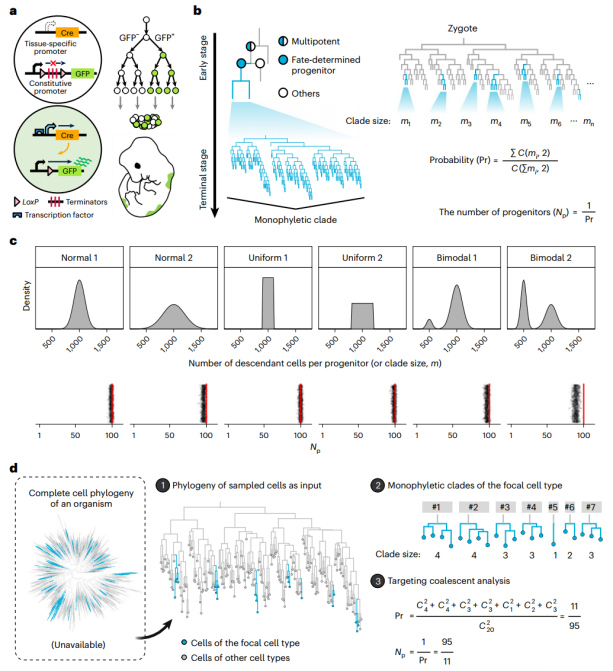
TarCA theory (figure from Nature Methods)
The study developed TarCA, a phylogeny-based statistical method for estimating the progenitor number of a cell population. The method bypasses the main limitation of traditional experimental approaches, which rely on pre-characterised markers to track progenitors. A particular advantage of TarCA is its versatility: it can analyse an organ, tissue, cell type or any cell population defined by the researcher, without prior knowledge of the progenitors. Another advantage is that it works powerfully on cell phylogenies that comprise only a small fraction of the total cells in a complex organism. Moreover, TarCA can produce stable estimates on erroneously reconstructed cell phylogenies, whereas monophyletic-clade-counting methods are highly sensitive to errors in phylogenetic reconstruction. With the growing popularity of reconstructed cell phylogenies, TarCA will be able to quantify the lineage diversity of all tissues of complex organisms, including humans, and will be the basis of quantitative models for understanding inter-individual developmental plasticity and age-dependent tissue degeneration.
The study, entitled "A statistical method for quantifying progenitor cells reveals incipient cell fate commitments", was published in Nature Methods. Shanjun Deng and Han Gong of Sun Yat-sen University are the co-first authors, and Prof. Xionglei He is the corresponding author.
Paper link: https://www.nature.com/articles/s41592-024-02189-7
对一个器官、组织或细胞群中祖细胞的数量进行量化,对于理解多细胞生物的发育和体内平衡至关重要。以前的研究依赖于在祖细胞中特异性表达的标记基因。然而,这种策略常常因缺乏理想的标记而受阻。
2024 年 2 月 20 日,中山大学贺雄雷团队在 Nature Methods 在线发表题为“A statistical method for quantifying progenitor cells reveals incipient cell fate commitments”的研究论文。该研究提出了一种通用的统计方法,通过探索记录细胞分裂历史的细胞系统发育树,来量化生物体中任何组织或细胞群体的祖细胞,即使在缺乏祖细胞特异性标记的情况下也是如此。
这种方法被称为靶向溯祖分析(TarCA),计算组织中两个随机抽样的细胞在组织特异性单系进化枝内溯祖的概率。这个概率的倒数可以用来衡量组织的祖细胞数目。数学模型和计算机模拟都证明了 TarCA 的高准确性,然后使用线虫、果蝇和小鼠的真实数据进行验证,所有数据都具有相关的细胞系统发育树。该研究进一步表明,TarCA 可用于鉴定胚胎发生过程中谱系特异性上调基因,揭示小鼠胚胎中早期细胞命运的承诺。
遗传多样性长期以来一直是理解生物种群进化动态的核心概念。在多细胞生物中,执行特定功能的细胞群体通常来自一组祖细胞,而祖细胞的数量决定了细胞群体的谱系多样性。在生物群体中,克隆扩增到固定在一个小的无性群体中是很常见的,细胞群体的低谱系多样性可能会增加相关组织对有害体细胞突变的易感性。一个突出的例子是由 2 万到 20 万个造血干细胞或多能祖细胞组成的人体血管系统。这种造血干细胞或多能祖细胞群对于防止年轻时血液中的克隆扩增至关重要,并解释了 70 岁后血液谱系多样性经常突然减少的原因。在多种实体器官或组织中也观察到这种年龄依赖性克隆扩增。因此,一种量化细胞群祖细胞数量的好方法对于理解组织稳态是有价值的。这对研究胚胎发育也很有用,因为胚胎发育涉及复杂的细胞群扩增和分化。
追踪细胞群祖细胞的最先进策略依赖于祖细胞特异性表达标记物,这些标记物可以被设计成标记后代细胞群。尽管有成功的案例,但该策略受限于对理想标记物的依赖,该标记物在目标细胞群的所有祖系中都有特异性表达。此外,这种方法是确认性的,而不是探索性的,因为它需要预先了解祖细胞,而且所揭示的祖细胞可能不是全部都能有效地促进后代细胞群。近年来,单细胞 RNA 测序(scRNA-seq)已被用于跟踪发育过程中的表达动态。尽管基于表达相似性的伪时间(pseudotime)发育轨迹在许多方面提供了信息,但由于解释高维表达数据的复杂性,它们无法准确识别细胞群体的祖细胞。
最近在绘制复杂生物(包括果蝇、斑马鱼、小鼠和人类)的细胞系统发育树图谱方面的技术进步,使得能够寻求基于系统发育的解决方案来应对上述挑战。这是因为,原则上,多细胞生物的个体发育可以用一个系统发育树来完全描述,其中根代表合子,分叉代表有丝分裂细胞分裂,终端节点(叶)代表采样时生物体中存在的终端细胞。
TarCA 理论(图源自 Nature Methods)
该研究开发了 TarCA,一种基于系统发育的统计方法,用于估计细胞群体的祖细胞数量。该方法绕过了传统实验方法依赖于预表征标记物来追踪祖细胞的主要限制。TarCA 的一个特殊优势是它的多功能性,可以分析器官、组织、细胞类型或研究人员定义的任何细胞群,而无需事先了解祖细胞的信息。另一个优点是,它在只占总细胞一小部分的细胞系统发育中也能发挥强大作用。此外,TarCA 可以在包含错误的重构细胞系统发育中产生稳定的估计;相比之下,单系进化枝的计数方法对系统发育重建中的错误高度敏感。随着重建细胞系统发育的日益普及,TarCA 将能够量化包括人类在内的复杂生物所有组织的谱系多样性,这将是理解个体间发育可塑性和组织年龄依赖性退化的定量模型的基础。
该研究以“A statistical method for quantifying progenitor cells reveals incipient cell fate commitments”为题发表在 Nature Methods。中山大学邓善俊、龚晗为本文共同第一作者,贺雄雷教授为通讯作者。
原文链接:https://www.nature.com/articles/s41592-024-02189-7