National Science Review | New result from Sun Yat-sen University: 99.9% similarity — mutation signatures trace the natural host of SARS-CoV-2National Science Review | 中山大学最新成果:99.9%相似性!突变特征追溯新冠病毒的自然宿主
2021-12-19
Since the outbreak of COVID-19, the origin of SARS-CoV-2 has been debated, one main reason being that RaTG13, the closest relative found to date, shares only 96.1% nucleotide similarity with SARS-CoV-2. Yet for the two previous coronavirus outbreaks this century (SARS in 2003 and MERS in 2012), a closely related virus with over 99% nucleotide similarity to the causative virus was found in wild animals shortly after each outbreak began. So what is the natural host of SARS-CoV-2, and which viral strains is it most closely related to?
On 4 December 2021, a paper entitled "Mutation signatures inform the natural host of SARS-CoV-2" was published in National Science Review. In this paper, the group of Xionglei He at Sun Yat-sen University analysed coronavirus mutation signatures and found that the mutation spectrum of SARS-CoV-2 is 99.9% similar to that of RaTG13, while another coronavirus found in horseshoe bats, RshSTT182, shares about 93% similarity with SARS-CoV-2. This suggests that before the outbreak SARS-CoV-2 existed in almost the same host environment as RaTG13 and RshSTT182.
Source: National Science Review
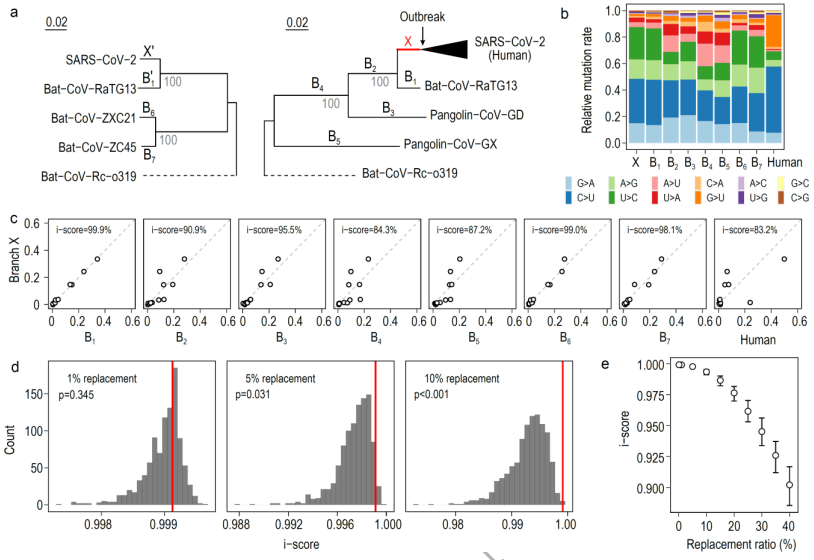
In the analysis, the researchers selected SARS-CoV-2 and six related viruses. The six related viruses were chosen because they are evolutionarily close enough for reliable mutation inference, and because at least three different hosts - bats, pangolins and humans - are involved, highlighting the complex host history of this viral lineage. The researchers also constructed two independent phylogenetic trees: branch X represents the pre-outbreak history of SARS-CoV-2, and B1 represents the history of RaTG13 after it split from SARS-CoV-2; both trees are present.
To quantify the similarity between two mutation spectra, the researchers computed an identity score (i-score), defined as the proportion of the total rate variation explained by the x = y dimension in a two-dimensional plot of the two spectra; an i-score of 100% means the two viral mutation spectra are 100% identical.
Source: National Science Review
The researchers found three phenomena: (1) branch X is almost identical to B1, with an i-score of 99.9%; (2) branch X differs from the post-outbreak branch of SARS-CoV-2 (the human branch), with an i-score of 83.9%; (3) branch X is generally highly similar to branches with bats as the putative host (B1, B6 and B7), and less similar to branches involving non-bat hosts.
Based on these results, especially the 99.9% identity between X and B1, the researchers proposed that SARS-CoV-2 is unlikely to have been artificially synthesised, because a synthesised genome would be unlikely to show a mutation spectrum similar to that of a naturally evolved viral genome (RaTG13).
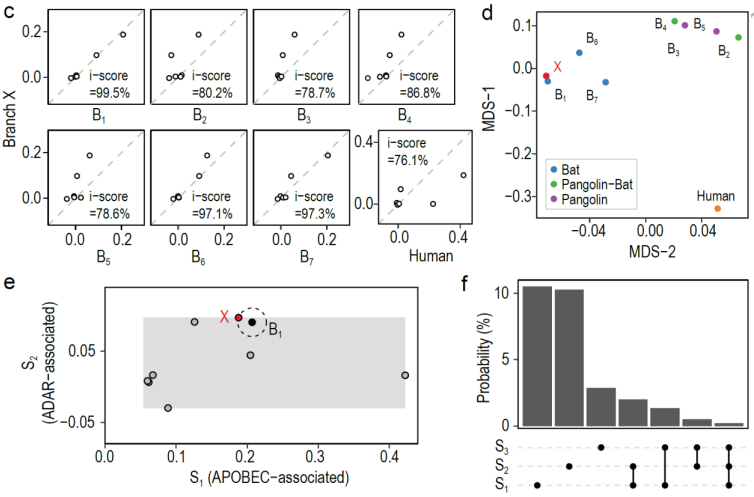
Source: National Science Review
Further analysis of host signatures showed that the host signatures of branch X and B1 are almost identical (i-score 99.5%), despite major deviations from branches related to humans or pangolins. A multidimensional proportional plot showed that X almost completely overlaps B1, lies close to B6 and B7, and is far from other branches. Replacing RaTG13 with other bat coronaviruses (RshSTT182 and BANAL-52) gave essentially the same results, with genomic homology to SARS-CoV-2 of 92.6% and 96.8%, respectively. These results indicate that before the outbreak SARS-CoV-2 shared almost the same host environment as RaTG13.
The study, entitled "Mutation signatures inform the natural host of SARS-CoV-2", was published in National Science Review. Shanjun Deng and Ke Xing of Sun Yat-sen University are the co-first authors, and Prof. Xionglei He is the corresponding author.
自 COVID-19 爆发以来 SARS-CoV-2 的起源一直争论不休,其中一个主要原因是迄今为止发现与 SARS-CoV-2 最接近的近亲 RaTG13,与 SARS-CoV-2 只有 96.1% 的核苷酸相似性。而本世纪爆发的前两次冠状病毒(2003 年的 SARS 和 2012 年的 MERS),均在野生动物中发现了一种与致病病毒具有 99% 以上核苷酸相似性的密切相关病毒。到底 SARS-CoV-2 的自然宿主是什么呢?与哪些病毒株的亲缘关系更近呢?
2021 年 12 月 4 日,一篇题为 Mutation signatures inform the natural host of SARS-CoV-2 的文章发表在 National Science Review 上。在这篇文章中,来自中山大学贺雄雷课题组通过对冠状病毒突变特征的分析发现,SARS-CoV-2 的突变谱与 RaTG13 的突变谱具有 99.9% 的相似性,而另一种在菊头蝠中发现的冠状病毒 RshSTT182 与 SARS-CoV-2 有约 93% 的相似性。这表明 SARS-CoV-2 在爆发前与 RaTG13 和 RshSTT182 几乎存在于相同的宿主环境中。
图片来源:National Science Review
研究者在分析中选择了 SARS-CoV-2 和六种相关病毒。选择这六种相关病毒是因为它们在进化上足够接近,可以进行可靠的突变推断,同时至少有三种不同的宿主(包括蝙蝠、穿山甲和人类)参与其中,突出了这种病毒谱系的复杂宿主历史。同时,研究者构建了两个独立的系统发育树,分支 X 代表 SARS-CoV-2 爆发前的历史,B1 代表 RaTG13 从 SARS-CoV-2 分裂后的历史,这两个系统发育树都包含在内。
为了量化两个突变谱之间的相似性,研究者计算了一个特征分数(i-score),它是在两个谱的二维图中由 x = y 维度解释的总速率变化的比例;当 i-score 等于 100% 时,意味着两个病毒突变谱 100% 相同。
图片来源:National Science Review
研究者在分析中发现三个现象:①分支 X 与 B1 几乎相同,i-score = 99.9%;②分支 X 与 SARS-CoV-2 爆发后的分支(即人类分支)不同,i-score = 83.9%;③分支 X 通常与以蝙蝠为假定宿主(B1、B6 和 B7)的分支高度相似,而与涉及非蝙蝠宿主的分支不太相似。
根据这些结果,尤其是 X 和 B1 的 99.9% 鉴定结果,研究者提出 SARS-CoV-2 不大可能是由人工合成的,因为合成的基因组不可能显示与自然进化的病毒基因组(RaTG13)类似的突变谱。
图片来源:National Science Review
进一步对宿主特征(host signatures)的分析表明,分支 X 与 B1 的宿主特征几乎相同,i-score = 99.5%,尽管与人类或穿山甲相关分支存在重大偏差。多维比例图显示 X 几乎与 B1 完全重叠,靠近 B6 和 B7,与其他分支相距较远。研究者用其他蝙蝠冠状病毒(RshSTT182 和 BANAL-52)替换 RaTG13 后发现基本相同的结果,其与 SARS-CoV-2 的基因组同源性分别为 92.6% 和 96.8%。这些结果表明,SARS-CoV-2 在爆发前与 RaTG13 共享几乎相同的宿主环境。
该研究以“Mutation signatures inform the natural host of SARS-CoV-2”为题发表在 National Science Review。中山大学邓善俊、邢珂为本文共同第一作者,贺雄雷教授为通讯作者。