Nature Methods | He lab develops an efficient lineage-tracing system to build the developmental cell lineage tree of DrosophilaNature Methods | 贺雄雷团队开发高效谱系追踪系统构建果蝇发育细胞谱系树
2021-12-03
The phylogenetic tree of species reveals the evolutionary relationships among extant species on Earth. At the microscopic scale, the kinship among all cells of an individual organism can be described by a cell lineage tree. Cell lineage is important for understanding physiological and pathological processes of multicellular organisms such as embryonic development, cell-type differentiation, and organ maintenance and ageing, and lies at the frontier of molecular evolutionary biology and developmental biology. In 1983, John Sulston and colleagues used microscopy to observe and record the division history of the 671 cells during embryogenesis of Caenorhabditis elegans, obtaining the first complete cell lineage tree of a multicellular organism [1]. Later, radioisotopes, enzymes and fluorescent labelling were gradually applied to track cell kinship, but with limited success. In recent years, somatic mutation information has been used for cell lineage tracing [2-4]. To overcome the low background mutation rate, efforts have focused on DNA barcode-based technologies that use efficient gene-editing tools such as Cre-LoxP and CRISPR-Cas9 to edit specific barcode regions [5,6], reconstructing the cell lineage by recording the mutations that accumulate with cell division. However, current barcoding technologies carry on average only 3-5 mutations per barcode, far from enough to describe the full picture of embryogenesis in complex multicellular organisms.
On 2 December 2021, Prof. Xionglei He's group at the School of Life Sciences, Sun Yat-sen University, published a research paper in Nature Methods entitled "Mapping single-cell-resolution cell phylogeny reveals cell population dynamics during organ development". The paper introduces a cell lineage tracing system based on single-base substitutions, SMALT (substitution mutation-aided lineage tracing system). The system offers a very large labelling space with more than 1,000 potential mutation sites, and a single barcode can record on average more than 20 mutations, making it suitable for lineage tracing in complex multicellular organisms.
SMALT works by using a deaminase (AID) targeted to the DNA barcode via the I-SceI domain, converting C bases in the sequence into U through deamination; during DNA replication, U pairs with A, producing C>T mutations (Fig. 1). The researchers optimised the components of SMALT on a self-built yeast screening platform, then generated transgenic Drosophila lines carrying the SMALT system, achieving for the first time reliable description of cell lineage relationships during embryogenesis in a complex multicellular organism at single-cell level (Fig. 2). This provides new research ideas for understanding the contribution of cell lineage to development and phenotypic stability.
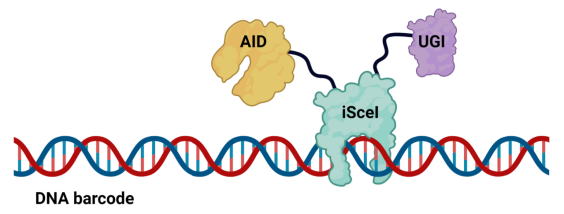
Fig. 1 Schematic of the SMALT system
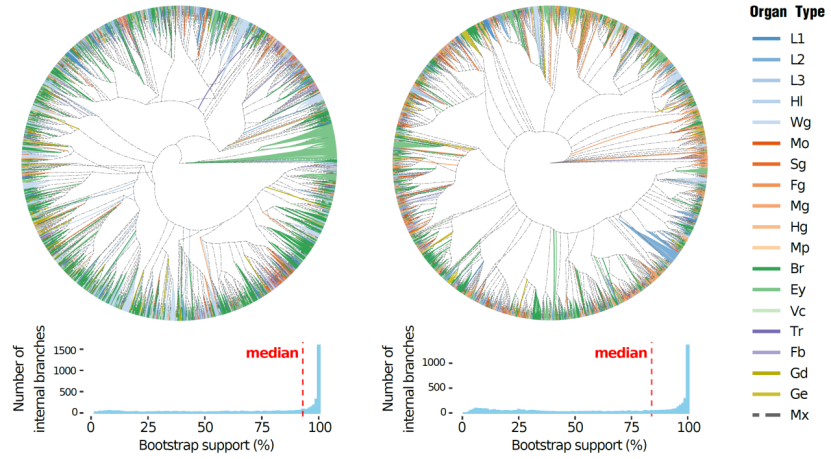
Fig. 2 High-resolution cell lineage trees reconstructed in two Drosophila individuals
Complex multicellular organisms have a huge number of cells, and capturing all of them is unrealistic, which means the reconstructed cell lineage tree is only a subset of the individual's cell lineage tree. Repeated sampling of the same individual may yield different cell populations. Therefore, research on the cell lineage of complex multicellular organisms should not stop at tree reconstruction and intuitive description; mathematical models should be used to quantify the lineage tree, infer the cell population history it reflects, and extract deeper biological features. To this end, drawing on coalescent theory from population genetics, the researchers developed an analytical method (an instantaneous coalescence estimation of parental cells with active division, ICPD) that uses the cell lineage tree to infer the number of actively dividing ancestral cell populations. The method does not depend on population structure and can infer the population-history features of each organ's development from the cell lineage tree. They found that different organs have distinct population-history features that are highly consistent across individuals (Fig. 3). Compared with imaginal discs, larval organs have a more complex origin history [7,8].
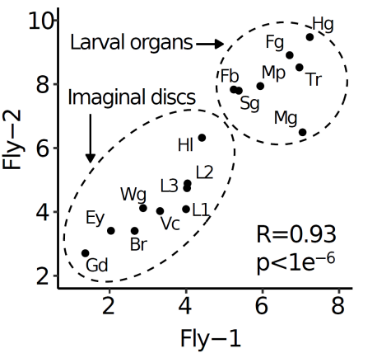
Fig. 3 Divergence times of organs in Drosophila larvae
Although the growth and division rates of individual cells vary, organ size and shape are strikingly reproducible across populations. Using the population-history features extracted by ICPD, the researchers inferred the number of newly generated cells in each organ and found that the total number of cells produced by division in each organ was significantly correlated with the true cell number of the organ, explaining 74.5% of its variance, revealing the contribution of cell population division activity to the stability of organ size and further showing that the cell lineage tree contains the underlying logic of embryogenesis in complex multicellular organisms (Fig. 4).
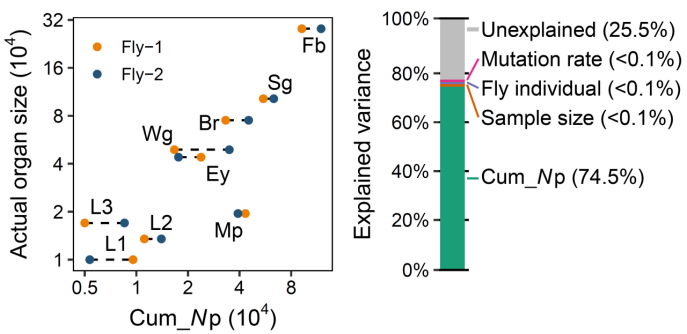
Fig. 4 Cumulative ancestral cell number is consistent with the true total cell number of the organ
The cell lineage tracing system and the cell-lineage-tree-based population-genetics analytical method developed in this study provide new technical and methodological means for reconstructing the embryogenesis of complex multicellular organisms. Combined with single-cell multi-omics, they are expected to provide quantitative insights into core developmental-biology questions such as the robustness of mammalian organ development and the mechanisms of cell fate conversion.
Prof. Xionglei He and Associate Prof. Li Liu of the School of Life Sciences, Sun Yat-sen University, are the co-corresponding authors; Ph.D. students Kehui Liu, Shanjun Deng and Chang Ye are co-first authors, and Zeqi Yao, Jianguo Wang and Han Gong are co-authors.
Paper link: https://doi.org/10.1038/s41592-021-01325-x
物种的系统发育树可以展现地球上现存物种间的进化关系。微观尺度上,一个生物个体所有细胞的亲缘关系可以用细胞谱系树来描述。细胞谱系对于理解多细胞生物的胚胎发育、细胞类型的分化、器官的维持与衰老等生理病理过程具有重要意义,是分子进化生物学与发育生物学的交叉前沿。1983年,John Sulston 等人利用显微镜观察并记录了秀丽隐杆线虫胚胎发育过程 671 个细胞的分裂历史,首次获得一个多细胞生物完整的细胞谱系树【1】。随后放射性元素、酶和荧光标记等方法也逐渐应用于细胞亲缘关系的追踪,但效果欠佳。近年,体细胞的突变信息被用于细胞谱系追踪【2-4】。为了解决本底突变率较低的问题,人们着力于发展基于 DNA 条形码(barcode)的技术,借助 Cre-LoxP、CRISPR-Cas9 等高效的基因编辑工具,对特定的 DNA 条形码区域进行编辑【5,6】,通过记录伴随细胞分裂过程产生的突变来还原细胞谱系。然而,目前的条形码技术平均每个条形码只携带 3-5 个突变,远不足以描述复杂多细胞生物胚胎发育的全貌。
2021 年 12 月 2 日,中山大学生命科学学院贺雄雷教授团队在 Nature Methods 上发表了题为“Mapping single-cell-resolution cell phylogeny reveals cell population dynamics during organ development”的研究论文。文章介绍了一种基于单碱基突变的细胞谱系追踪系统 SMALT(substitution mutation aided lineage tracing system)。该系统具有极大的标记空间,含超过 1000 个潜在突变位点,单个条形码平均可记录超过 20 个突变,适用于对复杂多细胞生物进行谱系追踪。
SMALT 系统的工作原理是利用脱氨酶(AID)通过 I-SceI 蛋白功能域靶向到 DNA 条形码序列,将序列上的 C 碱基通过脱氨反应变成 U 碱基;在 DNA 复制时,U 碱基会与 A 碱基配对,从而产生 C>T 突变(图 1)。研究人员在自主搭建的酵母筛选平台中对 SMALT 系统的各个元件进行了优化,继而通过构建 SMALT 系统转基因果蝇品系,首次实现在单细胞水平上对复杂多细胞生物的胚胎发育过程中的细胞谱系关系进行可靠描述(图 2),为了解细胞谱系对个体发育与表型稳定性的贡献提供了新的研究思路。
图 1 SMALT 系统示意图
图 2 在两个果蝇个体中构建高分辨细胞谱系树
复杂多细胞生物具有海量的细胞数目,对所有细胞进行捕获是不现实的,这意味着重构得到的细胞谱系树只是个体细胞谱系树的子集。对同一个体进行重复抽样可能得到不同的细胞群体。因此,对于复杂多细胞生物细胞谱系的研究不能停留在对谱系树的构建与直观的描述上,应该尝试利用数学模型对谱系树进行量化,推断其反映的细胞群体历史,提取更深层的生物学特征。为此,研究人员借助群体遗传学的溯祖理论,开发了利用细胞谱系树还原具有分裂活性的祖先细胞群体数量的分析方法 ICPD(an instantaneous coalescence estimation of parental cells with active division)。该方法不依赖于群体结构,可从细胞谱系树推断出各器官发育过程的群体历史特征。他们发现,不同器官具有独特的群体历史特征,并且该特征在不同个体具有高度一致性(图 3)。相较于成虫盘,幼虫器官具有更复杂的起源历史【7,8】。
图 3 果蝇幼虫各器官的分歧时间
尽管每个细胞个体的生长与分裂速度各不相同,但器官大小与形状在群体中却有惊人的重复性。通过 ICPD 分析提取的群体历史特征,研究人员对各器官的新生细胞数进行了推断,发现各器官中分裂产生的细胞总数与器官的真实细胞数量显著相关,对其方差解释度达到 74.5%,揭示了细胞群体的分裂活性对器官大小稳定性的贡献,进一步说明细胞谱系树中包含了复杂多细胞生物胚胎发育中的底层逻辑(图 4)。
图 4 累计祖先细胞数量与真实器官细胞总数具有一致性
该研究开发的细胞谱系追踪系统以及基于细胞谱系树的群体遗传学分析方法,为还原复杂多细胞生物胚胎发育的过程提供了新的技术手段与研究方法,结合单细胞多组学研究方法,有望对哺乳动物器官发育的鲁棒性、细胞命运转换机制等发育生物学的核心问题作出定量解析。
中山大学生命科学学院贺雄雷教授与刘黎副教授为本文的共同通讯作者,博士研究生刘科辉、邓善俊、叶畅为并列第一作者,姚泽奇、王建国、龚晗为共同作者。
原文链接:https://doi.org/10.1038/s41592-021-01325-x